
A dying banana, a forgotten American fruit, and an exploding exotic trade—are pointing to the same radical future. Here’s what Sunday grocery shopping looks like when they arrive. And what it costs.
Maya gets to the farmers market early because the good stuff goes fast. The idea that produce has urgency is new.
She’s 36, lives in a mid-sized city, and has been genuinely excited about grocery shopping for about four years now, which still surprises her. She grew up in the era of the identical banana. She didn’t know there was anything to be excited about.
This Sunday she has three stops. She always does it this way now. Not everyone does.
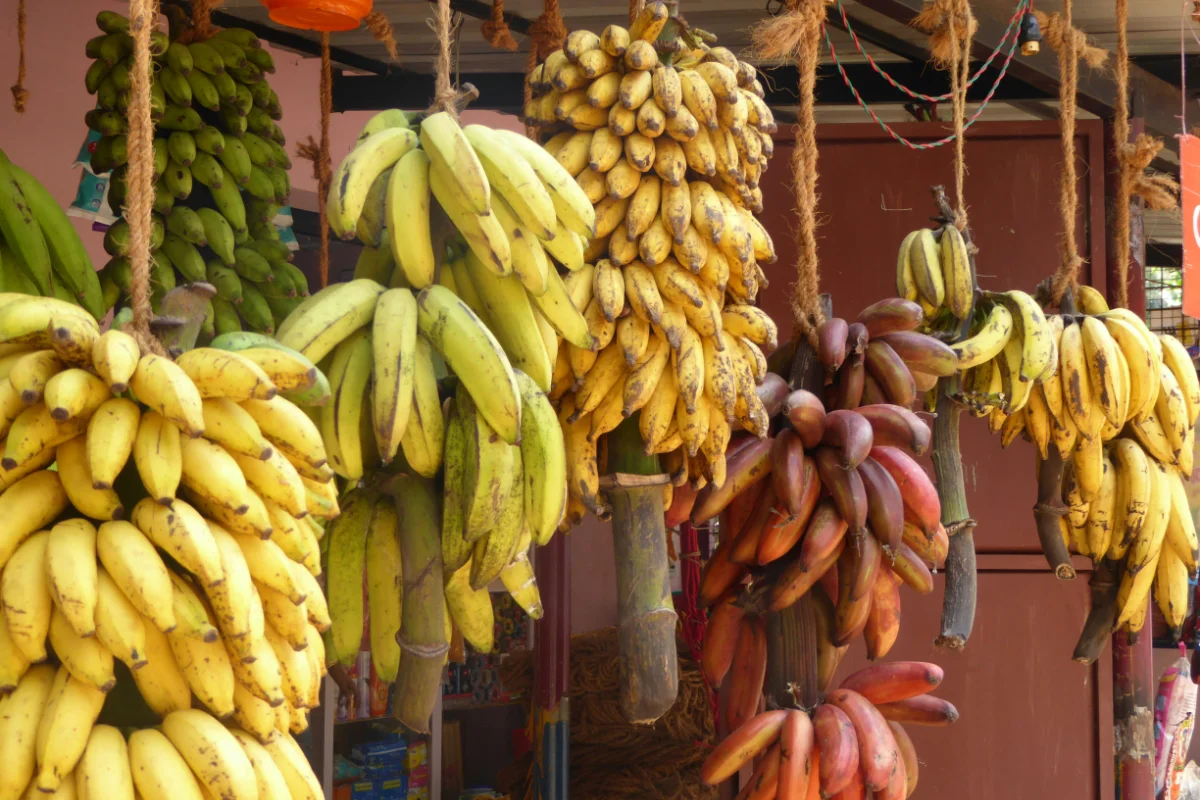
Signal One: The Cavendish banana, the world’s dominant commercial variety, faces potential extinction from a fungal disease. The Cavendish became dominant through industrial monoculture farming: cloned, genetically identical plants grown at massive scale for uniformity and profit. That same genetic sameness is its fatal vulnerability. The disease has now spread from Taiwan across Africa, Australia, and most recently Ecuador, the world’s largest banana exporter. Solutions exist such as gene-edited varieties, shifting consumers toward the 1,000+ other banana species. But each faces barriers: regulatory resistance, consumer skepticism, deeply ingrained taste preferences.
Signal Two: The pawpaw is North America’s largest native edible fruit, growing wild across 26 eastern states, yet virtually absent from grocery stores. Once a staple for Native Americans, eaten by Founding Fathers, and sustaining the Lewis and Clark expedition, the pawpaw faded as industrial agriculture reshaped food systems around shelf life, uniformity, and scale. The pawpaw resists all of that because it bruises easily, ripens unpredictably, and lasts only days. Today a quiet revival is underway: festivals, university gene banks, small farms, and passionate advocates are reintroducing it regionally. Rather than forcing it into mass production, proponents celebrate its scarcity as a feature. You have to seek the pawpaw.
Signal Three: The 2025 Fruit Logistica Report reveals a significant restructuring of global fresh produce trade, worth over US$230bn. While traditional commodity fruits like bananas, apples, and oranges are stagnating or declining in volume, premium and exotic categories like berries, avocados, durian, cherries, tropical fruits are driving explosive growth. Peru’s blueberry exports grew over 1,100% in five years. Thailand’s durian trade with China became the single largest fresh fruit trade flow globally, valued at US$4.8bn. Countries once peripheral to global trade — Morocco, Egypt, Colombia, Tanzania — are rapidly scaling premium exports. Consumers worldwide are increasingly willing to pay more for novelty, nutrition, and experience over familiar staples.
Each signal represents a shift from one logic of food to another:
The question the signals don’t answer is: for whom?
Here’s what that direction looks like when it arrives and who gets to experience it.
A family is selling four varieties of pawpaw, labeled by tree name — Sunflower, Shenandoah, Susquehanna — with handwritten tasting notes: Custard-forward. Tropical. Best eaten day-of. A small sign explains the harvest window: three weeks, starting now. Come back in October and they’ll be gone until next year.
Two tables down, a young grower is selling something Maya doesn’t recognize. Small, ridged, amber-colored. “Pineapple guava,” he says. “My grandfather grew them in his backyard.”
This is the thing about the farmers market in 2032 that’s hard to explain: it’s not just fresher produce. It’s denser with story. Every table has a provenance, a reason, a personality. Some just fell in love with a weird fruit and built a business around it.
She doesn’t linger on the fact that she spent $41 before 9 AM. Or that the market is in a neighborhood where the median income is $30,000 higher than the city average.
The produce section hits her the way it always does now: a low-grade dissonance, familiar but off.
The banana section is smaller. The Cavendish collapse didn’t wipe them out but the banana is subtly different now. Slightly starchier. The label still reads Cavendish, and Kroger stocks two other varieties alongside it: a red banana from Honduras and a Goldfinger she hasn’t tried. A cheerful card explains: We’re expanding our banana family!
The Goldfinger is $1.09. The red banana is $1.49. Variety has a price. Not everyone can pay it.
Market of Choice in 2032 is less a grocery store than an argument about what food should be. An entire section is dedicated to heritage and regional varieties — fruits commercially extinct for nearly so a decade ago. Pawpaws. Seckel pears. Black Oxford apples. Maypop passion fruit, native to the American South, nearly lost before a network of Appalachian growers revived it in 2027.
The international section is extraordinary and a little overwhelming. Fresh durian in three varieties, with a staff member who knows the difference and explains it without condescension. Mangosteens, rambutans, and jackfruit.
Maya smiles. Then catches herself wondering: what happens when everyone wanting it means someone figures out how to grow it at scale, in identical conditions, on cleared land in three countries, until this too becomes a monoculture with a story stapled to it? The Cavendish banana, after all, was once somebody’s exciting new variety.
The banana crisis forces the hand. When disease causes a meaningful disruption to global banana supply, it won’t just be a food story — it will be an economic crisis for nations whose agricultural GDP depends on a single clone. That crisis will do what decades of ecological advocacy could not: force governments, retailers, and consumers to take crop biodiversity seriously. Biodiversity, for the first time, will become a mainstream consumer value rather than an environmentalist talking point.
The pawpaw effect scales up. The cultural appetite for seasonal, local, “earned” food experiences — currently the domain of farmers markets and food festivals — will move into the mainstream. Food tourism will grow around harvest windows. Retailers will experiment with intentional scarcity: limited-run, hyper-seasonal produce that creates the anticipation currently reserved for sneaker releases.
The exotic becomes ordinary. The produce aisle of 2035 will look unrecognizable to a shopper from 2015. Durian will sit next to apples in cities with significant populations. Nations that master premium supply chains will become the new agricultural powers, displacing commodity giants who optimized for a world that no longer exists.
The deeper shift: from commodity to relationship. For most of the 20th century, the goal was abundance and affordability — get calories to everyone, everywhere, cheaply and consistently. That project largely succeeded, and in succeeding, it flattened the food landscape into a monoculture of both biology and culture. The next decade will be defined by the reaction against that flatness: a demand for diversity, story, seasonality, and resilience that comes from consumers, farmers, and — increasingly — from nature itself.
Every compelling future has a shadow. This one has two, and they’re worth naming clearly.
The first shadow: two food systems, not one. The diversified, story-rich food world Maya moves through is real — but it runs on disposable income, flexible time, and proximity to the right neighborhoods. The commodity system doesn’t disappear when the premium world flourishes; it retreats, becomes starker, and serves everyone who can’t afford three stops. Variety has a price.
As the food system diversifies at the top, it risks calcifying at the bottom — leaving the most vulnerable eaters in a world that looks increasingly like the monoculture everyone else is celebrating the end of. A food system that solves for novelty without solving for access isn’t a revolution. It’s a rebrand.
The second shadow: novelty becomes the next monoculture. The most historically grounded risk in this forecast is hiding in plain sight, because we’ve already watched it happen once. The Cavendish didn’t start as a monoculture — it started as the exciting replacement for the Gros Michel, a better banana for a new era. Then demand scaled. Growers responded with the only logic industrial agriculture knows: plant more of the same thing.
The very diversity the market is now celebrating is one successful harvest cycle away from the same fate. When durian demand reaches a scale that justifies industrial production, someone will figure out how to grow a single, high-yield variety at massive scale. Wild pawpaw groves, already under pressure from foragers chasing the revival, are a smaller version of the same story: consumer appetite for the authentic has a way of consuming the very thing it loves.
These shadows don’t cancel the forecast. But they complicate it — and any honest reading of where the food system is heading has to hold both the possibility and the peril in the same hand.
Maya sits in the parking lot before starting her car, backseat full of bags from three different places, three different logics of what food is for.
She thinks about her mother — one store, one stop, the same banana every morning for thirty years. Who found “food tourism” slightly absurd. You drive somewhere to eat a fruit?
She doesn’t feel superior to that. She feels a quiet grief for the simplicity of it. There was something clean about a familiar yellow fruit being enough. And something she’s only recently begun to sit with: her mother’s single-stop, single-banana Sunday was available to almost everyone. This Sunday — her Sunday, with its pawpaws and jackfruit — is not.
But she also feels something like understanding — it has textures and stories and vulnerabilities she can see. Understanding the food system, however, is not the same as fixing it. Knowing the story of your pawpaw doesn’t feed the person who can’t afford to go looking for one.
None of this makes Sunday morning grocery shopping simple. It makes it, instead, complicated in ways that feel worth paying attention to — which is different from meaningful, but might be the necessary step before it.
The direction is already clear — you don’t have to wait for 2035 to act on it:
The pawpaw has been growing wild in American forests for thousands of years, waiting. The question the next decade answers is whether we’re finally ready to go find it.
Sources: Fruit Logistica 2025 Trend Report · Vox: “The Banana is Under Threat” · CBS This Morning: "A Sweet Celebration of Paw Paw Fruit"